


Hands-on learning does more than keep students busy. It gives young people a practical way to organise ideas, test understanding, present thinking and build confidence through doing. Whether the setting is a secondary classroom, TAFE workshop, university tutorial, workplace training room or youth skills program, the right classroom learning tools can turn information into action.
The Australian Bureau of Statistics reported that 63% of Australians aged 15 to 24 were studying in May 2025, while 8% were not engaged in any work or study. At the same time, the Australian Curriculum, Assessment and Reporting Authority found that 86.7% of 15 to 19-year-olds were fully engaged in education, training or work in 2025. These figures show the scale of youth skills development already underway, and the importance of equipping learning spaces with practical supplies that support participation, structure and progress.
6 Supplies That Help Build Practical Learning Skills
1. Notebooks: The Starting Point for Better Thinking
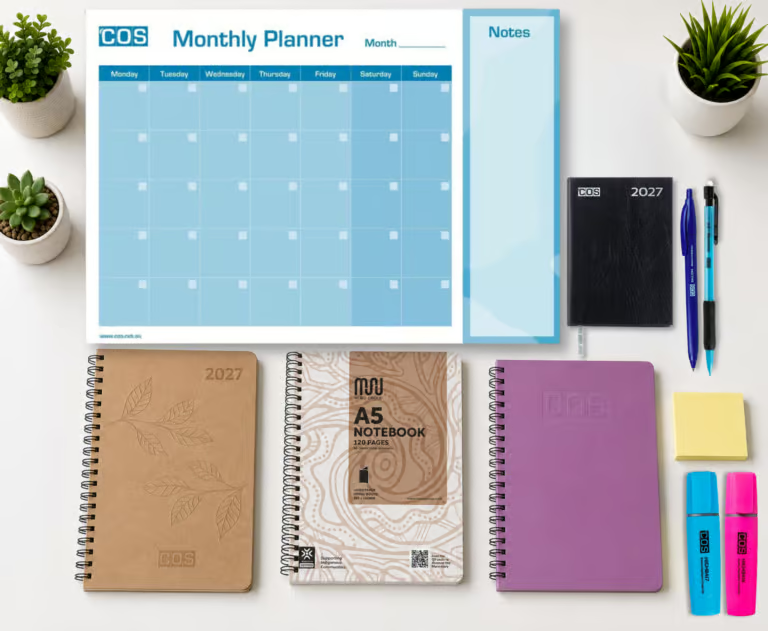
Every skills-building environment needs somewhere for ideas to land. Notebooks and pads give students and trainees a consistent place to record instructions, sketch concepts, capture observations and reflect on what they have learned. A page of notes can connect a demonstration to a practice activity, a group discussion to a final presentation, or a mistake to a better second attempt.
Good notetaking also supports information retrieval and revision. Research from the NSW Centre for Education Statistics and Evaluation identifies explicit teaching, effective feedback and the use of assessment to guide learning as evidence-informed practices that improve student outcomes. Notebooks help make those practices visible by giving learners a place to write success criteria, respond to feedback and track progress over time.
2. Display Books: Turning Work into Evidence
In practical learning environments, progress is easier to understand when it can be seen. Display books help students and trainees collect worksheets, project drafts, assessment evidence, reference sheets and presentation notes in one place. They are especially useful for youth skills programs, where learners may need to show growth across multiple sessions or demonstrate competency through completed tasks.
A display book also creates a sense of ownership. Instead of loose handouts disappearing into bags, students can build a portfolio that shows where they started, what they practised and what they can now do. For trainers and teachers, that makes review conversations more specific.
3. Binders: Structure for Multi-Step Learning
Hands-on learning often involves several moving parts: safety instructions, worksheets, activity guides, assessment criteria, reflection prompts and reference material. Binders and filing supplies help keep those resources structured and accessible. This is particularly important in training rooms where learners may move between theory, group work and practical demonstration in a single session.
For teachers, trainers and facilitators, a consistent binder system also makes it easier to prepare materials, update content and support different ability levels within the same group.
4. Whiteboards: Making Thinking Visible
A whiteboard is one of the most flexible training room tools, as they turn thinking into something the whole group can see, question and improve. Whiteboards can be used to map a process, collect student ideas, demonstrate a calculation, list success criteria, run a quick quiz or capture group feedback at the end of a session.
For hands-on learning, shared visibility is powerful. Students can see how an expert breaks down a task. They can contribute suggestions without needing a finished answer. They can compare approaches and correct misconceptions in real time, supporting active participation, especially for students who may learn better through demonstration, discussion and visual cues than through written instructions alone.
5. Sticky Notes, Tabs and Flags: Small Tools for Active Learning
Small tools can have an outsized effect on classroom organisation. Sticky notes allow learners to sort ideas, label questions, vote on priorities and plan project steps. Tabs and flags make it easy to mark important pages in workbooks, binders and display books. Used well, these supplies help learners interact with content rather than simply receive it.
6. Writing and Marking Supplies: The Everyday Essentials
Pens, pencils, markers and highlighters are easy to overlook because they are so familiar, but they are the everyday tools that keep learning moving. In a hands-on session, students may need to annotate instructions, label diagrams, draft a response, highlight key information, markup a process or prepare a quick presentation outline.
Make these supplies visible and accessible rather than treating them as emergency items locked away in a cupboard. A simple caddy on every table or desk can remove unnecessary interruptions and encourage learners to take ownership of their work. In rooms used by different classes, teams or cohorts, clear storage and restocking systems prevent small shortages from becoming regular disruptions.
How to Set Up a Skills-Building Learning Space
The best classroom learning tools work together. A notebook supports individual thinking. A whiteboard supports shared thinking. A binder supports structure. A display book supports evidence. When these tools are planned as a system, the learning space becomes easier to use for everyone.
Start by mapping the learning journey. What do the students need before the session begins? What will they handle during the activity? What should they take away afterwards? From there, stock supplies around the way people move through the room. Keep notebooks, pens and sticky notes where learners sit. Keep whiteboard markers and erasers with the board. Store binders, display books and presentation materials near the area where group work is prepared.
For multi-use training rooms, consistency is especially important. Labels, colour coding and clearly marked storage make it easier for facilitators to walk into a room and begin. They also reduce the mental load on learners, which is valuable when the session already involves new information, unfamiliar tasks or assessment pressure.
Why Practical Learning Supplies Matter More Than You Think
It is easy to think of notebooks, binders and writing equipment as basic stationery, but in practice, they help shape how learners participate. They can turn passive listening into active notetaking, loose worksheets into organised records, group discussion into visible thinking and finished tasks into evidence of progress.
Australian Bureau of Statistics education data shows the breadth of Australia’s learning system, from schools and preschool through to vocational education, university and adult training. In 2025, Australia had more than 4.16 million school students enrolled across 9,673 schools, with an average student to teaching staff ratio of 12.8 students to one teacher. Supplying learning spaces well is therefore not a minor operational detail. It is part of supporting a large, diverse and active education system.
Hands-on learning needs practical support. Stock rooms well. Keep them organised. Give learners the tools to record, sort, present and improve their thinking. That is how everyday supplies become skills-building classroom and training tools for hands-on learning.