


Every workplace has a culture, whether anyone has deliberately shaped it or not. It shows up in how quickly a new starter feels like part of the team, whether good work gets noticed, how smoothly information travels around a staffroom, and what it feels like to walk into a shared space at the end of a long day. Building a stronger workplace culture does not require a big program or a large budget. It comes from the consistent application of a handful of everyday habits that quietly shape how people experience their workplace.
4 Operational Levers to Help Build Workplace Culture
Here is how to build stronger culture through four operational levers: onboarding, recognition, communication, and shared spaces.
1. Onboarding: How the First Weeks at Work Set the Tone
How a new staff member spends their first few weeks shapes how they feel about the organisation for years afterwards. A disorganised, unclear onboarding process signals that the school or workplace does not have its own systems sorted, which quietly undermines confidence before a new employee has even settled in.
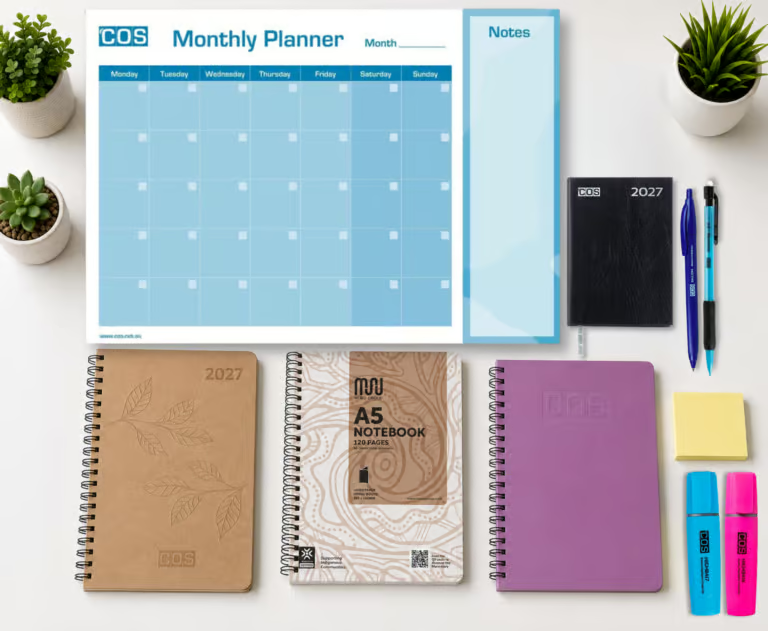
Practical onboarding improvements do not need to be elaborate. A welcome pack with the essentials, a labelled desk or workspace ready before their first day, and a planner or diary pre-loaded with key dates and meetings all communicate that someone thought ahead on the new person’s behalf. For schools, this might mean a folder with term dates, staff meeting schedules, and key policies ready at a new teacher’s desk on day one rather than emailed in fragments across the first fortnight.
Teacher retention research gives this extra weight. A Monash University study surveying 8,000 teachers, school leaders and education support staff in Victoria found that only 31% intend to remain in the profession beyond 10 years, and of those planning to leave, 76% intend to do so within five years. Working conditions and day to day experience of the workplace are consistently identified as factors in that decision, and a strong start is part of that experience.
2. Recognition: Small, Visible, Consistent Actions Establish Habits
Recognition works best when it is frequent and visible rather than reserved for end of term functions. A noticeboard in a staffroom dedicated to shout outs, messages of thanks, and small wins costs almost nothing to set up and gives colleagues an easy, low-pressure way to acknowledge each other regularly.
The format matters less than the consistency. Sticky notes pinned to a board, a handwritten card left on a desk, or a five-minute mention at a staff briefing all achieve the same goal: making people feel that their contribution was actually seen. Simple stationery such as coloured cards, markers, and pins can turn a blank noticeboard into a genuine culture building tool if the habit of using it becomes part of the weekly rhythm rather than a one-off gesture.
3. Communication: Reducing Friction, Not Adding Noise
Culture breaks down fastest when communication is unclear or inconsistent. Staff who do not know what is happening, when, or why tend to disengage, regardless of how good the underlying culture might otherwise be.
A shared wall planner in a staffroom, visible to everyone, reduces the number of “wait, when is that due” conversations that quietly erode trust in how well organised a workplace is. For meetings, having reliable meeting supplies on hand, notepads, pens, and a properly stocked whiteboard, means sessions run smoothly rather than starting with someone hunting for a working marker.
Encouraging respectful communication is not a single lesson, poster or policy launch. It is a continuous practice, and the same principle that shapes classroom culture applies to staff culture too. Clear, consistent communication habits, modelled from leadership down, do more for workplace culture than any single all staff email.
4. Shared Spaces: What the Physical Environment Communicates
The state of a shared space sends a message before anyone says a word. Piles of paper, tangled cables, and overflowing supplies do not just look untidy, they actively create friction in the day, slowing decision making and making simple tasks feel heavier than they should. A staffroom or shared office that feels chaotic communicates that no one has taken ownership of the space, which subtly signals that the people who use it are not being looked after either.
For schools specifically, a 2023 Australian Education Research Organisation report found that well-structured environments improve engagement and reduce transition friction, a finding that applies to staff workspaces as much as classrooms.
Simple fixes make a genuine difference. Desk organisers and drawer dividers keep shared stationery findable rather than scattered, a well-maintained noticeboard keeps communication current rather than cluttered with outdated notices, and a properly stocked supply cupboard means staff are not wasting time searching for basics during a busy week.
Building Workplace Culture as a Daily Practice
Building a strong company culture does not require a large budget or a formal culture initiative. What they require is treating culture as an operational responsibility rather than an abstract value. A well-planned first week, a noticeboard that actually gets used, a shared calendar that removes uncertainty, and a staffroom that feels cared for are small, repeatable actions that compound over a term or a year into something that genuinely feels like a positive place to work.
Strong workplace culture is not a single initiative. It is the sum of what happens every ordinary day, and most of the changes needed are well within reach, whatever the size of the team or the budget behind it.